

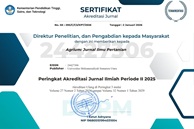
AGRIUM: Jurnal Ilmu Pertanian applies an initial editorial screening followed, where appropriate, by a double-blind peer review process. All submissions are managed through the Open Journal Systems (OJS) platform. Manuscripts that meet the initial editorial requirements are considered for further assessment by reviewers with relevant academic expertise.
1. Editorial Screening and Review Process
| Stage | Description |
|---|---|
| 1. Submission | The author submits an anonymised manuscript and a separate title page through the online submission system. |
| 2. Initial Editorial Screening | The editor checks the manuscript's relevance to the journal's scope, completeness of documents, compliance with the article template and author guidelines, initial scientific suitability, required declarations, ethical requirements, and similarity using Turnitin (maximum acceptable similarity: 20%). Manuscripts that do not meet the requirements may be returned to the authors for correction or rejected. |
| 3. Reviewer Assignment | Manuscripts that pass the initial editorial screening may be assigned to reviewer(s) whose academic expertise is relevant to the subject. Reviewer selection is determined by the editor according to the topic and specific requirements of each manuscript. |
| 4. Peer Review | Reviewer(s) evaluate the manuscript and submit comments and recommendations to the editor. AGRIUM applies a double-blind peer review method, in which reviewers do not know the identity of the authors, and authors do not know the identity of the reviewers. |
| 5. Editorial Decision | The editor evaluates the review reports and the scientific quality of the manuscript before making an editorial decision: accept, minor revision, major revision, or reject. |
| 6. Revision | Authors revise the manuscript according to the editor's and reviewer(s)' comments and submit a point-by-point response. Revised manuscripts may undergo further assessment when necessary. |
| 7. Acceptance and Production | Accepted manuscripts proceed to copyediting, layout editing, author proofreading, DOI registration, and publication. |
2. Reviewer Selection and Assessment
Reviewers are selected based on their academic expertise and the subject of the manuscript. The editor considers potential conflicts of interest when selecting reviewers. Suggestions from authors may be considered, but the final selection remains the responsibility of the editor.
Reviewers assess the manuscript based on the following aspects:
- Originality, novelty, and scientific contribution.
- Appropriateness of the research design, methods, data, and statistical analysis.
- Consistency between the results, discussion, and conclusions.
- Relevance, currency, and accuracy of references.
- Clarity of language and quality of tables and figures.
- Relevant research ethics considerations.
3. Review Timeline
| Process | Target Time |
|---|---|
| Reviewer invitation response | Maximum 7 calendar days |
| Review completion | Maximum 14 working days |
| First editorial decision | Target maximum 30 working days from the commencement of the peer review stage |
| Minor revision | 14 calendar days |
| Major revision | 30 calendar days |
These timelines are editorial targets and may vary depending on reviewer availability, manuscript complexity, and the time required for author revisions. Extensions may be granted with the editor's approval. Authors will be informed of significant delays.
The 30-working-day target refers to the first editorial decision after the peer review stage begins. It does not guarantee manuscript acceptance or publication within that period. The overall publication timeline depends on the review process, revision rounds, author responses, and production requirements.
4. Editorial Decisions
| Decision | Meaning |
|---|---|
| Accept | The manuscript is accepted without further revision (OJS: Accept Submission). |
| Minor Revision | Small changes are needed. The editor checks the revised version, with the help of reviewer(s) if necessary (OJS: Revisions Required). |
| Major Revision | Substantial changes are needed. The revised manuscript may be sent for a further review process (OJS: Resubmit for Review). |
| Reject | The manuscript is not suitable for publication in AGRIUM (OJS: Decline Submission). |
When reviewer recommendations conflict, the editor may invite an additional reviewer. The final editorial decision is made by the editor based on the reviewer comments, the scientific quality of the manuscript, and the authors' responses to the required revisions. The Editor-in-Chief has the final authority over manuscript acceptance, rejection, and publication.
5. Confidentiality
Manuscripts and review reports are confidential. Reviewer and author identities are concealed from each other during the double-blind peer review process. Reviewers must not share or use unpublished manuscript content and must not upload manuscripts to generative AI tools. Reviewer comments are communicated to authors anonymously.
Policy last reviewed: November 2026.
Agrium: Jurnal Ilmu Pertanian indexing:


Office:
Gedung Fakultas Pertanian Universitas Muhammadiyah Sumatera Utara
(Kampus Utama UMSU)
Jl. Kapten Muchtar Basri No.3, Glugur Darat II,
Kec. Medan Timur, Kota Medan, Sumatera Utara - 20238
Email:
agrium@umsu.ac.id